

 EN
EN  ES
ES Study records increase in public investment directed at children and adolescents in the Dominican Republic
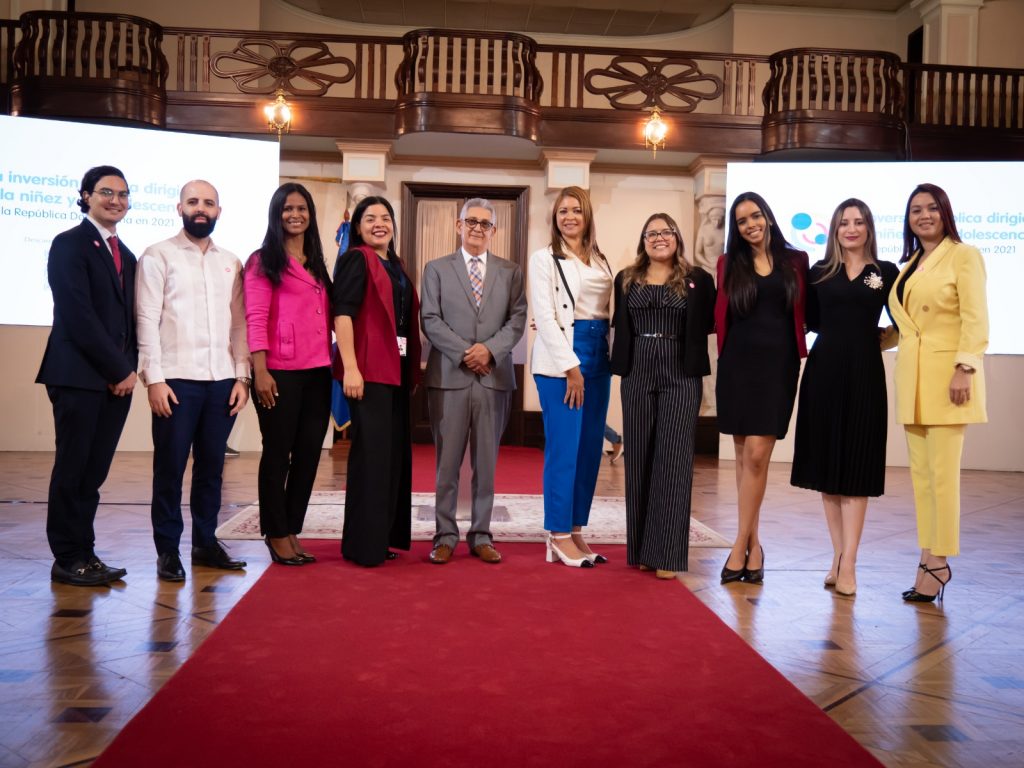
The study, presented by Digepres, Conani, MEPyD, and UNICEF, indicates an increase from 5.11% of GDP in 2016 to 5.71% of GDP in 2021. 901% of the funds are the result of internal savings and increased efficiency in public spending. The General Directorate of Budget (DIGEPRES), together with the Ministry of Economy, Planning and Development (MEPyD), the National Council for Children and Adolescents (CONANI), and the United Nations Children's Fund (UNICEF), launched the study "Public Investment Directed at Children and Adolescents in the Dominican Republic in 2021," sponsored by the Children and Adolescents Cabinet (GANA-RD), chaired by First Lady Raquel Arbaje. The launch, held at the National Palace, was led by the First Lady and the Director General of Budget, José Rijo Presbot. Luisa Ysabel Ovando de Sánchez, Executive President of the National Council for Children and Adolescents (CONANI); Mauricio Ramírez, United Nations Resident Coordinator in the Dominican Republic; and Rosa Elcarte, UNICEF Representative in the country, were present. The study aims to quantify the public investment allocated to children and adolescents in the Dominican Republic in 2021, both directly and indirectly. It also analyzes and monitors the financial efforts undertaken by the State to guarantee the fulfillment of the rights of children and adolescents. In her keynote address, the First Lady stated that “this percentage of investment places us well above the regional average for countries in Latin America and the Caribbean” and clearly demonstrates that children and adolescents are a priority for the government of President Luis Abinader. The First Lady also highlighted the work of the General Directorate of Budget (Digepres) and the measures implemented that aim at internal savings and more efficient spending through the General State Budget. “I want to thank José Rijo, from the Budget Directorate (Digepres), because 901% of the resources used in this investment come from our savings, from the people's public funds, for the people,” Arbaje stated. For his part, Rijo Presbot acknowledged the Government's efforts, which, even in the face of a wartime economy, have been able to prioritize investment in such a vulnerable sector, in addition to the creation of the Cabinet for Children and Adolescents, as a clear indicator of this administration's political will. “At Digepres, we remain committed to efficiency and quality management of public spending, and to that end, we are developing a project that, starting in 2024, will allow for multi-year, results-based budgeting,” the Budget Director announced. During the event, it was emphasized that research is a tool for fiscal policy to promote a more tailored administration of financial resources that takes into account needs and policies aimed at children and adolescents. This analysis provides objective and up-to-date financial information to improve coordination among decision-makers: those responsible for designing public policies and programs. Rosa Elcarte, UNICEF Representative in the country, highlighted that the increase in investment in children and adolescents demonstrates the country's progress and commitment to this public policy. "The study also included, for the first time, a novel perspective on institutional responses to disability within the population, which is an advance in the cross-cutting identification of responses to disability. This is a significant step for the country and the region to ensure that no one is left behind," Elcarte said. Education, social protection, and health are among the most relevant investments. The study's findings indicate that public investment directed toward children and adolescents in 2021 represented 5.7% of the Gross Domestic Product (GDP). This represents a 0.6 percentage point increase compared to 2016 and a sustained increase from 2011 to 2021. Furthermore, by life cycle, the study indicates that 33.2% of the investment was directly allocated to early childhood (ages 0-5); 39.1% to childhood (ages 6-12); and the remaining 27.7% to adolescence (ages 13-17). According to the study, the most significant investment in 2021 was directed towards education, representing 54.6% of the total. Social protection came in second with 16.8%, and investment in health programs for children and adolescents ranked third with 12.6%. The study presented by UNICEF, Digepres and MEPyD recommends continuing to prioritize investment in early childhood, increasing investment in care for children with disabilities; and, in particular, increasing public investment in protection against violence in childhood and adolescence.