


 EN
 ES
Milagros Ortiz: “Public ethics are achieved through the correct management of principles, norms, and collective commitment.”

The Director General of Ethics and Governmental Integrity made her remarks on the podcast “Let’s Talk About the Budget” as part of DIGEPRES’ Citizen Ethics Week. Milagros Ortiz Bosch, Director General of Ethics and Governmental Integrity (DIGEIG), reiterated that the Dominican Republic continues to consolidate its position in transparency, social oversight, and compliance with regulations, ranking among the top-rated countries. Ortiz Bosch indicated that the correct application of established principles and norms in public administration is essential for achieving transparency. She emphasized that this administration is working step by step to strengthen institutions, focusing on rigorous process monitoring and compliance with current regulations. “Public ethics are achieved when public servants make correct use of established principles and norms,” she stated. During her appearance on the podcast “Let’s Talk About the Budget,” hosted by Paola Chaljub, head of the Communications Department at the General Directorate of Budget (DIGEPRES), the director of DIGEIG emphasized that ethical values and transparency are fundamental to this administration. In her remarks, she noted that the country has positioned itself among the top countries in Latin America in matters related to budget control, achieving global recognition, which demonstrates a substantial improvement in the quality of spending and citizen accountability. Milagros Ortiz also indicated that, compared to previous years, no process is carried out without due process, and mechanisms are currently in place to guarantee greater transparency and institutional order. Among the measures implemented as part of these controls are the rejection of appointments without prior verification of funds, contracts without corresponding budget validation, and auditing processes. “These advances reflect the Dominican State’s commitment to more efficient and responsible public management, aligned with international best practices,” she stated. Milagros Ortiz Bosch concluded her remarks by highlighting that this approach allows the Dominican Republic to evolve toward a more organized management model, where compliance with regulations and constant oversight of public affairs are the fundamental pillars for achieving sustainable results and greater public trust. The podcast “Let’s Talk About the Budget” complements DIGEPRES’ efforts to continue promoting the right to know, transparency, and social participation as strategic axes of this budget management. CITIZEN ETHICS WEEK: DIGEIG mobilizes more than 100 public institutions with activities promoting integrity and transparency. This initiative unites state institutions around the values of transparency, regulatory compliance, and a culture of integrity. In commemoration of April 29, National Citizen Ethics Day, participating institutions hold talks, conferences, interviews, film screenings and discussions, contests, digital campaigns, exhibitions, murals, and reflection sessions, reaffirming the government’s commitment to integrity in public administration.
The Dominican Republic achieves a historic score of 82/100 in budget transparency and consolidates its leadership in Central America and the Caribbean in the 2025 Open Budget Survey

The country surpasses the Latin American and Caribbean average by 25 points, consolidating its place among the select group of nations with "Sufficient" levels of fiscal transparency according to the International Budget Partnership (IBP). The Dominican Republic has achieved its best historical score in the 2025 Open Budget Survey (OBS), reaching an outstanding score of 82 out of 100 in the Transparency pillar. This result positions the country, along with Brazil, as a regional leader in the timely and detailed publication of how the government manages and makes public resources transparent, far exceeding the Latin American and Caribbean average of 57 points. The General Directorate of Budget (DIGEPRES) views this milestone as validation of its institutional commitment to accountability and the Right to Know. The country has maintained sustained growth since 2015, when it scored only 51 points, reflecting a state policy focused on the complete opening of fiscal data. The OBS 2025 report highlights that the Dominican Republic publishes all eight key budget documents evaluated. In particular, the country achieved excellent scores in documents critical for social oversight, including the Pre-Budget Statement with a perfect score of 100/100, thanks to the expanded data on debt, revenue, and macroeconomic forecasts; the In-Year Reports, scoring 96/100, ensuring real-time monitoring of spending; and the Enacted Budget, reaching 95/100. Furthermore, the OBS 2025 report emphasizes the Dominican Republic's regional leadership in social participation and the timely publication of the Citizen's Budget, achieving a score of 84/100 and reaffirming its commitment to simplifying technical information for the entire population. In the area of Public Participation, the Dominican Republic scored 50 out of 100, nearly doubling the regional average of only 26. The International Budget Partnership (IBP) positively recognizes the creation of formal consultation spaces, such as the Municipal and Provincial Development Councils, which allow citizens to influence the budget process from the very beginning. Historic progress in social participation and sustained growth: Examining the historical evolution of social participation within the budget cycle reveals a paradigm shift in Dominican budget management over the last decade. After a period of fluctuations, with scores of 23 in 2015 and 17 in 2017, the country has achieved sustained and significant progress since 2021. The exceptional leap from a score of 22 in 2021 to the current 50 points in 2025 represents the consolidation of new channels for social dialogue and the strengthening of the development councils. This uninterrupted growth over the last two cycles not only doubles the regional average but also reaffirms DIGEPRES' commitment to transforming the budget into a tool for collective construction and effective social oversight. With this milestone, DIGEPRES reaffirms its commitment to working alongside the National Congress and the Chamber of Accounts to implement the recommendations of the Open Budget Survey (OBS) on Budget Oversight, which received a score of 56, as well as to fostering citizen participation in the discussion and approval phase of the General State Budget Bill. A Shared Achievement This result is the fruit of ongoing technical collaboration between the Government, international organizations, and civil society. DIGEPRES especially appreciates the support of the Solidarity Foundation and the commitment of the technical team at the Ministry of Finance and Economy, whose joint work has made the Dominican Republic a model of fiscal transparency for the world. The full report is available at internationalbudget.org.
New tool for labeling public spending allows progress towards achieving the 2030 SDGs: Ministry of Finance and UNDP present details to the Budget
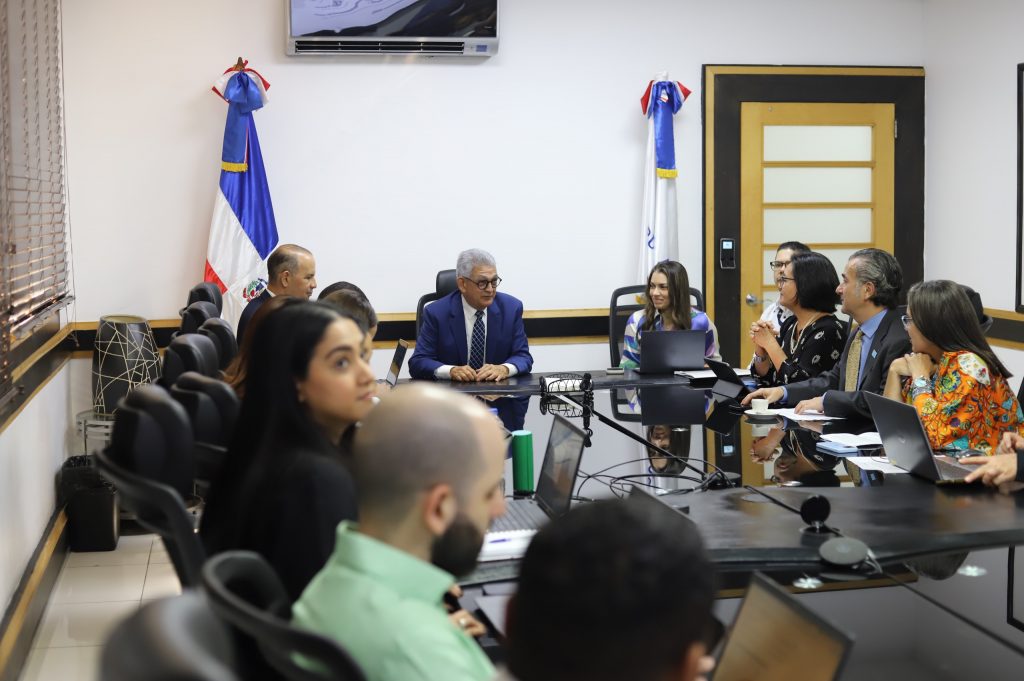
El Gobierno dominicano y el Programa de Naciones Unidas para el Desarrollo presentarán el caso de éxito de RD en el uso de la nueva herramienta de Inteligencia Artificial en materia presupuestaria en Foro Anual de Economía Sostenible en abril de 2026 en Chile. La Dirección General de Presupuesto (DIGEPRES) junto al Programa de las Naciones Unidas para el Desarrollo (PNUD) y el Ministerio de Hacienda y Economía sostuvieron un encuentro para presentar el proyecto de etiquetado del gasto público alineado con los objetivos de Desarrollo Sostenible (ODS) mediante inteligencia artificial. Iniciativa que busca fortalecer y contribuir al cumplimiento de la Agenda ODS 2030. En el encuentro destacaron el trabajo y liderazgo de República Dominicana en la búsqueda de acciones, herramientas e implementación a favor del cumplimiento de dicha agenda. Explicaron, además, que el proyecto de etiquetado del gasto público utiliza una plataforma tecnológica basada en inteligencia artificial para mejorar el seguimiento y análisis del gasto público e inversiones del Estado. La actividad estuvo encabezada por el director general de Presupuesto, José Rijo Presbot, junto a un equipo técnico de DIGEPRES, entre ellos Iván Ramírez, subdirector de Presupuesto; Odilys Hidalgo, directora de Servicios Presupuestarios; Rafael Jovine, director de Estudios Económicos; Ana Miguelina Terrero, encargada de Evaluación del Desempeño Presupuestario; Karla Ureña, encargada de Planificación y Desarrollo; Juan Portalatín, encargado de Gestión Financiera de Formulación y Ejecución; María Víctoria Ortíz, encargada de Normas y Metodologías; Alexander Hilario encargado de Tecnologías de la Información y Lowenski Matos, encargado de la División Desarrollo e Implementación de Sistemas TIC. también participaron representantes del Ministerio de Hacienda y Economía y del Sistema de Naciones Unidas. Rijo Presbot agradeció la participación de los presentes mientras valoró el apoyo que las entidades participantes han brindado para consolidar iniciativas orientadas al fortalecimiento de los procesos y la gestión pública. “Este respaldo ha permitido avanzar en la implementación de acciones que promueven una gestión más eficiente y sostenible”, apuntó. Del Ministerio de Hacienda y Economía, Nelson Chávez, director General de Desarrollo Económico y Social en representación de Martín Franco, viceministro de Planificación e Inversión Pública agradeció al PNUD por promover herramientas que permitan al país mejorar el desarrollo sostenible e institucionalidad. Agregó Chavez, que los esfuerzos se enmarcan en una visión más amplia de desarrollo y planificación a largo plazo, alineado con los grandes objetivos nacionales y el trabajo articulado. Inteligencia Artificial para desarrollo de Agenda ODS 2030 Julia Sánchez, coordinadora residente del Sistema de las Naciones Unidas en República Dominicana, explicó que el proceso que viene desarrollando junto al gobierno e instituciones privadas busca avanzar a las metas pendientes frente al tema. Asimismo, informó que el trabajo desarrollado hasta el momento en materia presupuestaria y planificación bajo la inteligencia artificial será presentado por el Gobierno dominicano y PNUD en el Foro Anual de Economía Sostenible en el mes de abril de 2026 en Chile. “Esta es una oportunidad para mostrar como la planificación y la ejecución del presupuesto pueden aportar al desarrollo del país”, dijo Sánchez en su intervención. Agregó la representante del PNUD que el trabajo conjunto que vienen desarrollando con las instituciones tendrá resultados de impacto de cara al futuro. Asimismo, Sánchez, dijo que un tema crucial para cumplimiento de la agenda ODS al 2030 es el financiamiento y que la herramienta ayudará con este propósito.