EN
 ES
Digepres and Fundación Solidaridad hold Citizen Meeting to socialize budget transparency tools
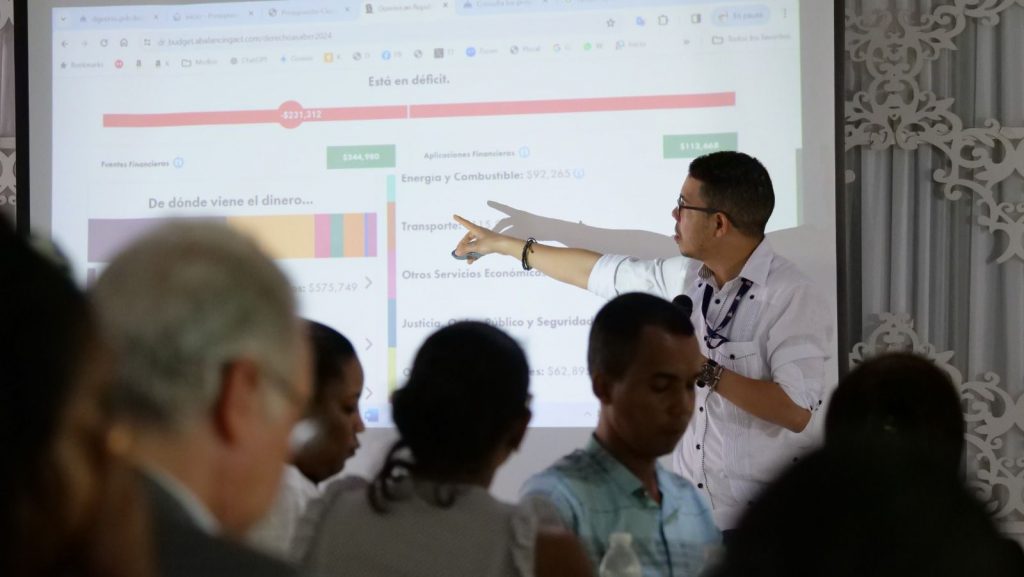
The Citizen Meeting held in Santiago aimed to highlight the importance of open budgeting practices to guarantee transparency and social oversight. Santiago – The General Directorate of Budget (Digepres) and the Solidarity Foundation held a Citizen Meeting to share available budget transparency tools and thereby improve access to clear and verifiable information on the use of public resources, strengthening accountability and citizen trust in government institutions. The meeting, held in Santiago de los Caballeros, also sought to highlight the importance of open budgeting practices to guarantee transparency and social oversight. Participants included Domingo Matías, Vice Minister of Territorial Planning and Regional Development of the Ministry of Economy, Planning and Development (MEPyD); Juan Castillo, Executive Director, and Kathia Lambis, Researcher, of the Solidarity Foundation; and Rafael Jovine, Director of Economic Studies and Financial Monitoring. Airon Fernandez, Budget Programs Specialist from the Budget Analysis and Economic Studies Department, and Marcos Gómez, from the Territorial Planning Office of the Santiago de los Caballeros City Council, were present. The welcoming remarks and objectives of the event were shared by Lambis, who emphasized the importance of these meetings for understanding how public resources are invested and their intended use. The first presentation was given by Domingo Matías from the Ministry of Economy, Planning and Development (MEPyD), who spoke about the challenges of territorial planning under the new municipal administration. Among his explanations, he highlighted the benefits that community input brings to the development projects compiled in their territories through the Single Registry of Territorial Citizen Demands (RUDCT), which are then considered in the national budget. Juan Castillo presented the results of the Open Budget Survey, which ranks the country fourth globally out of 125 countries and first among Latin American and Caribbean countries, according to data from the International Budget Partnership (IBP). “The Open Budget Survey (OBS) is the result of collaborative research between the International Budget Partnership (IBP) and civil society organizations in 125 countries, representing diverse regions and income levels over a 16-month period,” Castillo said. He also noted that the Survey is the only comparative and independent measure of budget transparency worldwide, regularly used by governments, donor agencies, and civil society organizations. Tools for Budget Transparency and Social Oversight: Rafael Jovine, Director of Economic Studies and Financial Budget Monitoring, presented the tools that bring the budget closer to citizens, increasingly closing the gaps and reducing budgetary discretion between public institutions and the public. “Previously, the public finance information available to officials was far more extensive than that available to the general public. This has decreased, and much of the information I will present is already accessible to you,” explained Rafael Jovine in his presentation. The economist outlined how to access information available on the Digepres portal, including interactive videos, citizen forums, documents, and reports that illustrate the state of public finances. He also presented the Citizen Budget portal, which summarizes the five volumes of the General State Budget (PGE). Among the tools shared by Jovine was the 2024 Budget Simulator, which allows citizens to see how revenues are spent and simulate income and expenditure allocations that best suit their preferences, within established parameters. This enables them to submit their “ideal budget” to the government, along with comments and opinions. He also addressed the PGE formulation process, the budget cycle, and the stages involved, such as formulation, discussion, approval, execution, and evaluation. Finally, Rafael Jovine emphasized the importance of constant citizen oversight of public resources to ensure they are used in strict accordance with the law. The event was attended by municipal officials and social organizations from the province interested in the topic and concluded with a question-and-answer session based on the information presented and current events in the country.